Did you know that you can navigate the posts by swiping left and right?
Walking naturally after spinal cord injury using a brain–spine interface
24 May 2023
. category:
Research
.
Comments
#neuroimaging
#epidural electrical stimulation
I am delighted to share our work published in Nature:
Walking naturally after spinal cord injury using a brain–spine interface
Nature, Vol. 618, No. 7963, pp. 126–133 (May 2023)
Henri Lorach, Andrea Galvez, Valeria Spagnolo, Felix Martel, Serpil Karakas, Nadine Intering, Molywan Vat, Olivier Faivre, Cathal Harte, Salif Komi, Jimmy Ravier, Thibault Collin, Laure Coquoz, Icare Sakr, Edeny Baaklini, Sergio Daniel Hernandez-Charpak, Gregory Dumont, Rik Buschman, Nicholas Buse, Tim Denison, Ilse van Nes, Léonie Asboth, Anne Watrin, Lucas Struber, Fabien Sauter-Starace, Lilia Langar, Vincent Auboiroux, Stefano Carda, Stephan Chabardes, Tetiana Aksenova, Robin Demesmaeker, Guillaume Charvet, Jocelyne Bloch, Grégoire Courtine
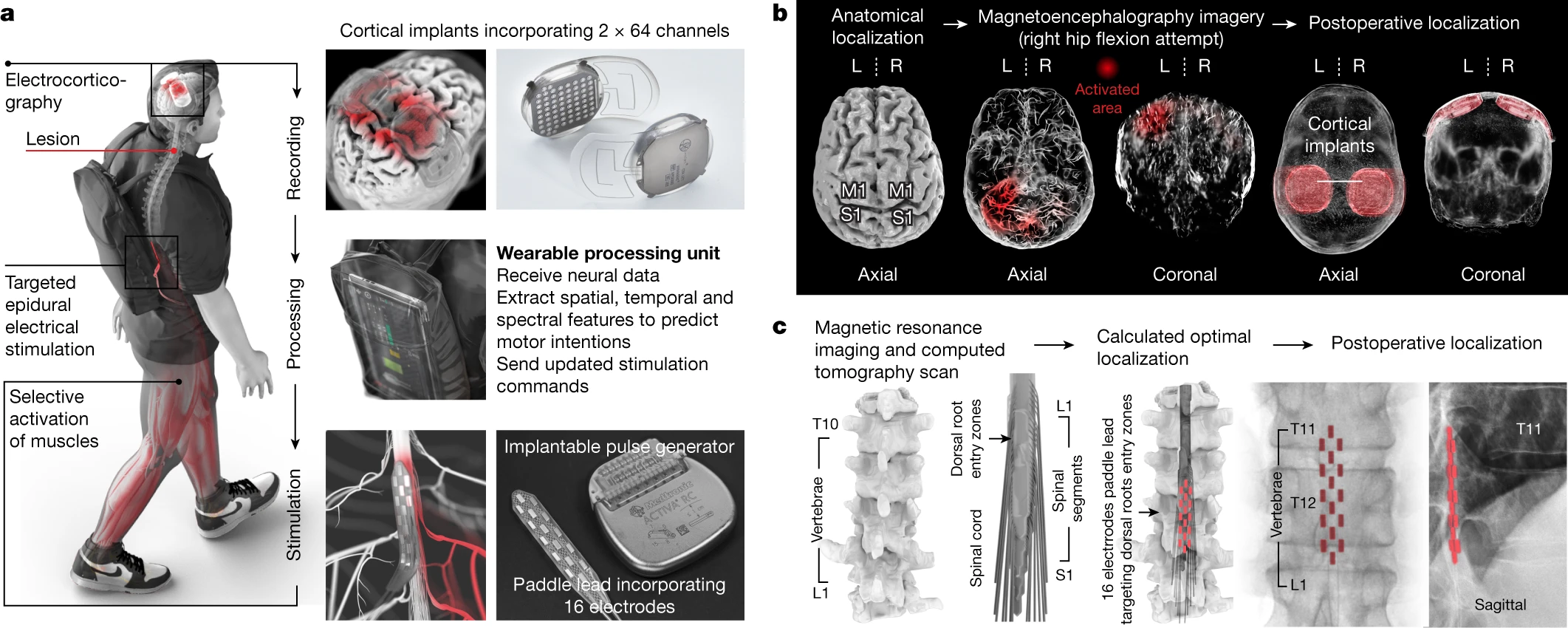
My contribution to this work centered on the personalized modelling of the spinal cord of the participant, who was implanted with both a spinal cord EES implant and a brain ECoG implant. Together, these two devices form what we call a Brain–Spine Interface (BSI) — a digital bridge that reads motor intention directly from brain signals and translates them in real time into targeted spinal cord stimulation. This closed-loop neuroprosthetic system enabled the participant to regain voluntary control over their own spinal cord stimulation and, remarkably, to achieve a natural walking pattern.
Sergio Daniel Hernandez Charpak is a PhD Computational Scientist, a Physicist and Computing Engineer researching in the interface between AI / medical imaging in healthcare, and also an enthousiast of travel, hiking, chess and piano.